TL;DR
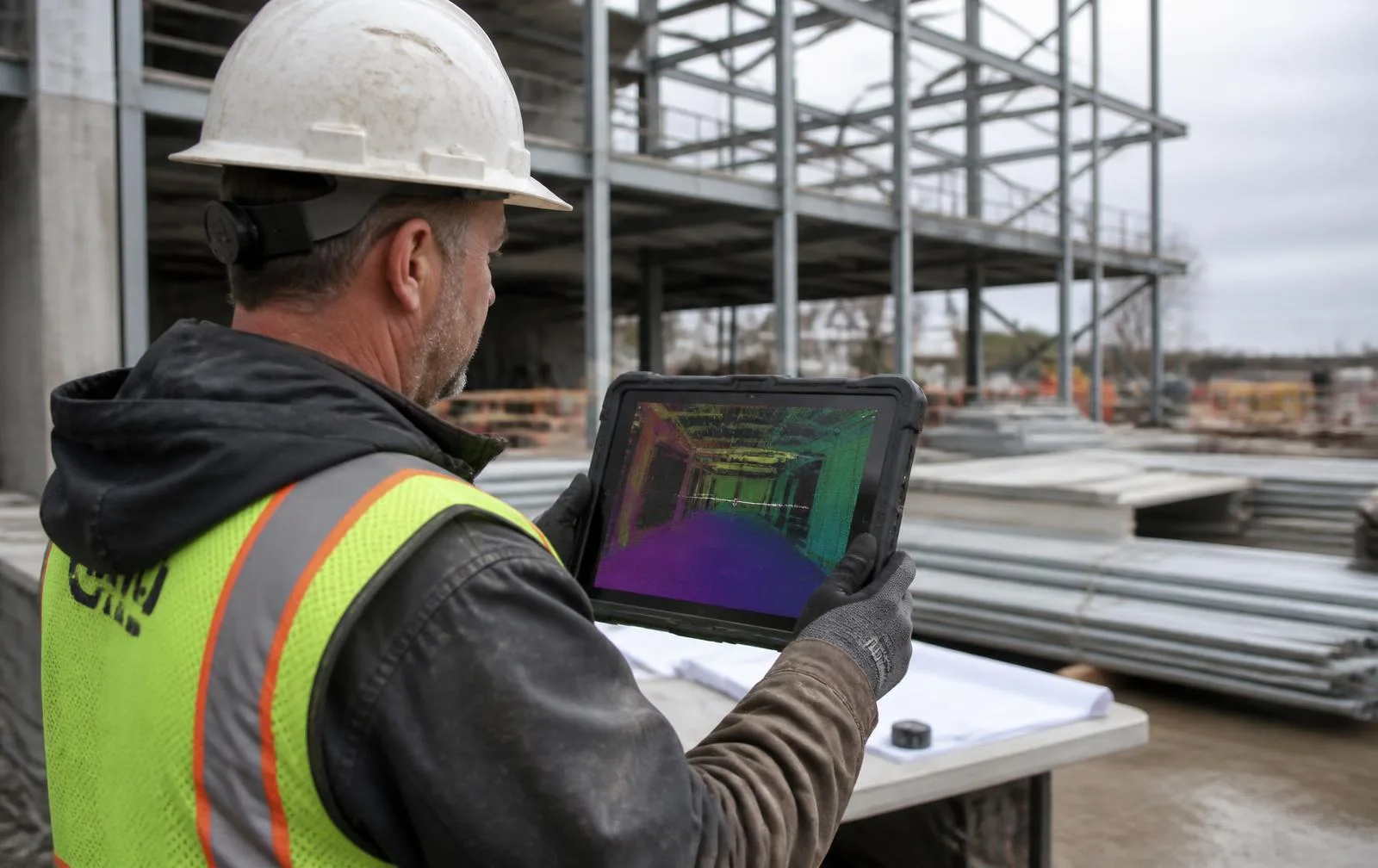
Point cloud files are enormous — typical project datasets run 25–150 GB — and most people who need to use one don't have the software license or the workstation to open it. Cloud hosting solves that by publishing the registered point cloud and its linked panoramas to a streaming browser viewer: the data loads progressively, measurement and section tools run right in the browser, and access is a link rather than an installation. Nobody on the team needs Revit or ReCap seats to use their own scan data.
Point cloud files are enormous — typical project datasets run 25–150 GB — and most people who need to use one don't have the software license or the workstation to open it. Cloud hosting solves that by publishing the registered point cloud and its linked panoramas to a streaming browser viewer: the data loads progressively, measurement and section tools run right in the browser, and access is a link rather than an installation. Nobody on the team needs Revit or ReCap seats to use their own scan data.
Why does this matter — what's the actual failure mode it fixes?
The most common way a scanning project loses value isn't a bad scan. It's a great scan that gets delivered once, sits on a drive, and never gets opened again — because the people who need answers from it can't open the file. A registered point cloud is genuinely too large and too specialized to email, and full CAD/BIM software isn't something every stakeholder on a project owns or needs for anything else. Hosting turns the data back into something people actually use.
What do you actually get in a hosted viewer?
| Feature | What it means in practice |
|---|---|
| Streaming browser viewer | Point cloud loads progressively — no local download, works on any device |
| Linked 360° panorama navigation | Photo-realistic context alongside the measured geometry |
| Measurement, sectioning, and clipping tools | Real dimensions, cut-away views, and room-by-room isolation — in the browser |
| Team access management | Multiple people, shareable links, no license per seat |
| Open-format masters (E57/RCP) delivered | Hosting is a layer on top of ownership, never a replacement for it |
A real project: one dataset, five kinds of stakeholders
A hospital renovation team's planning was nurses-station-by-nurses-station — designers, the GC, and facilities all needed the scan of a 38,400 sq ft wing, but only one seat of ReCap existed among all of them. We hosted room-level clipped clouds and corridor tiles in a browser viewer, so no one had to load 100+ GB locally. The GC pulled diffuser counts, door schedules, and millwork lengths directly from the hosted viewer during preconstruction — quantity takeoff work done from scan data, without a single full-dataset download.
Who actually needs hosted access?
- Owners whose teams don't run CAD or BIM software day-to-day
- GCs sharing conditions with a dozen subs at once, all from the same current dataset
- Design teams collaborating across separate firms without swapping file copies
- Facility managers using the scan for day-to-day operational questions
- Estimators pulling takeoff dimensions directly from measured geometry
Can hosting work for data you already own, not just a new scan?
Yes — hosting doesn't require a new capture. If your team already holds a registered point cloud from a previous scanning project, whether it came from us or another provider, that dataset can be published to the hosted viewer on its own, as a standalone service. That's a common path for owners who commissioned a scan months or years ago, received the raw files, and never had a practical way to get the rest of the team into them.
Do you lose ownership of your own data?
No — and this is worth being explicit about, because it's the one place a provider can quietly lock you in. Every hosted project at ZEALOT is backed by open-format master files — E57 and RCP — delivered to you outright, independent of the hosting service itself. If you change providers, drop hosting, or archive the project years later, the data is completely yours and completely usable elsewhere. We'd recommend requiring exactly that of any provider you host data through, not only us. See our point cloud file format guide for what those formats actually mean for your workflow.
How does a dataset actually get from scan to hosted viewer?
- Capture or import. We host data from our own scans, or registered clouds your team already owns from another provider.
- Optimize. Clipping, tiling, and streaming preparation, so a dataset that would choke a workstation loads smoothly in a browser instead.
- Publish. The project goes live in the viewer with whatever access rules you choose — open to the whole team, or restricted to specific people.
- Support. We onboard your team to the viewer and keep hosting live for the term you need, whether that's the length of a project or an ongoing facility record.
What changes for the project team once hosting is live?
Before hosting, the common failure pattern looks like this: a full-resolution point cloud gets emailed or handed off on a drive, one person on the team has the software to open it, and everyone else works from whatever screenshots or exports that one person is willing to send. After hosting, every stakeholder — the facilities coordinator, the millwork sub, the structural engineer — is looking at and measuring in the exact same dataset, the same afternoon, without a software purchase or an install. That's the real value: not just easier access, but everyone working from one current source of truth instead of scattered copies that quietly drift out of sync.
When does hosting make sense versus just getting the files?
If one person on one team will ever open the data, raw file delivery is fine. Hosting earns its cost the moment more than a couple of stakeholders need the same dataset — different firms, different software, rotating subcontractors, or a facility team that will keep coming back to the scan for years. At that point, point cloud and panorama hosting is usually the least expensive way to make sure a scan you already paid for keeps producing value instead of sitting on a drive.