TL;DR
Historic conversions start with measurement: a 150,000 sq ft building scans in about 3 days and models at LOD 300 in 12–15 business days, quantifying the out-of-plumb walls, dished slabs, and misplaced steel that break unit layouts. On a 1926 Cleveland factory that meant 24 RFIs avoided and roughly $190,000 in change orders that never materialized.
Old brick mills and department stores don’t come with clean spec sheets. In adaptive reuse, you inherit every shim, swaybacked joist, and unrecorded remodel from the last 100 years. If you’re planning apartments upstairs, that mess of unknowns can kill a budget fast. We model what’s actually there—down to the inch—so design and financing have something solid to stand on.
The reality of historic conversions: measure first, argue less
We see it across Ohio—Cleveland, Mansfield, Columbus, Cincinnati. Developers eye a vacant 1920s structure and ask, “Can we fit 80 units and meet preservation?” The truest answer starts with measurement, not guesswork. Original drawings, if they exist, rarely match field conditions. MEP systems hide in chases. Beams are where you don’t want them. Floor-to-floor heights are not as advertised.
Scan to BIM connects the dots between “what might be” and “what is.” Our Scan to BIM service combines high-speed 3D laser scanning and Revit modeling to deliver a dimensionally accurate as-built that teams can trust.
“If you can’t measure it, you can’t preserve it—and you definitely can’t price it.”
What do we actually deliver — and how will you use it?
From the first walk to the last sheet export, the deliverable is a coordinated model and documented set you can design with and submit to lenders, preservation boards, and the GC.
Included in a typical package:
- Architectural and structural as-built model (Revit): exterior walls, parapets, window/door openings, column grids, beams, floor slabs, load-bearing elements
- Floor-to-floor heights and spot elevations, including slab deviations (±6–8 mm registration to survey control; floor flatness maps optional)
- Visible MEP routing captured as-is: ducts, mains, risers, major conduit and piping
- Interior partitions, stairs, railings, select casework, arches, decorative moldings where preservation-sensitive
- Sheet-ready views for sections/elevations and dimensioned floor plans
- Point cloud files for reference or independent QA: E57, RCP, or LAS; see our guide to point cloud formats
Typical model detail:
- LOD 200 for massing and early feasibility
- LOD 300 for unit planning, MEP coordination, and permit drawings
- Targeted LOD 350/400 for specific assemblies (e.g., stair geometry, ornate entries) when required by the design scope
Explore how to right-size detail: LOD 200 vs 300 vs 400.
Field workflow: walking-pace capture, tripod where it counts
We blend mobile and terrestrial scanning because speed matters, but so does tight geometry.
- Interior capture with NavVis VLX3 (mobile LiDAR, SLAM). Walking pace coverage at 50,000–80,000 sq ft/day per unit. Typical point spacing 5–10 mm at 10 m.
- Tripod control with Leica RTC360 or Faro Focus for stair cores, roofs, long corridors, and exterior facades where line-of-sight matters.
- Registration tied to survey control points/targets. We run cloud-to-cloud registration, then lock it to control to hold global accuracy.
- QA: section cut overlays and deviation heatmaps to verify slab level, wall plumb, and structural alignment before modeling starts.
Numbers you can plan around:
- 120,000–180,000 sq ft building: 2–4 field days with two techs
- Raw data volume: 150–300 GB before indexing; 20–40 GB for deliverable RCP
- Registered accuracy to control: ±6–8 mm; local precision tighter in tripod zones
- Modeling timeline: 10–20 business days for LOD 300 architecture/structural plus visible MEP
For a deeper dive on mobile capture, see Inside the NavVis VLX3 and our take on mobile vs. traditional surveying.
Cleveland anecdote: the biscuit factory that wouldn’t square up
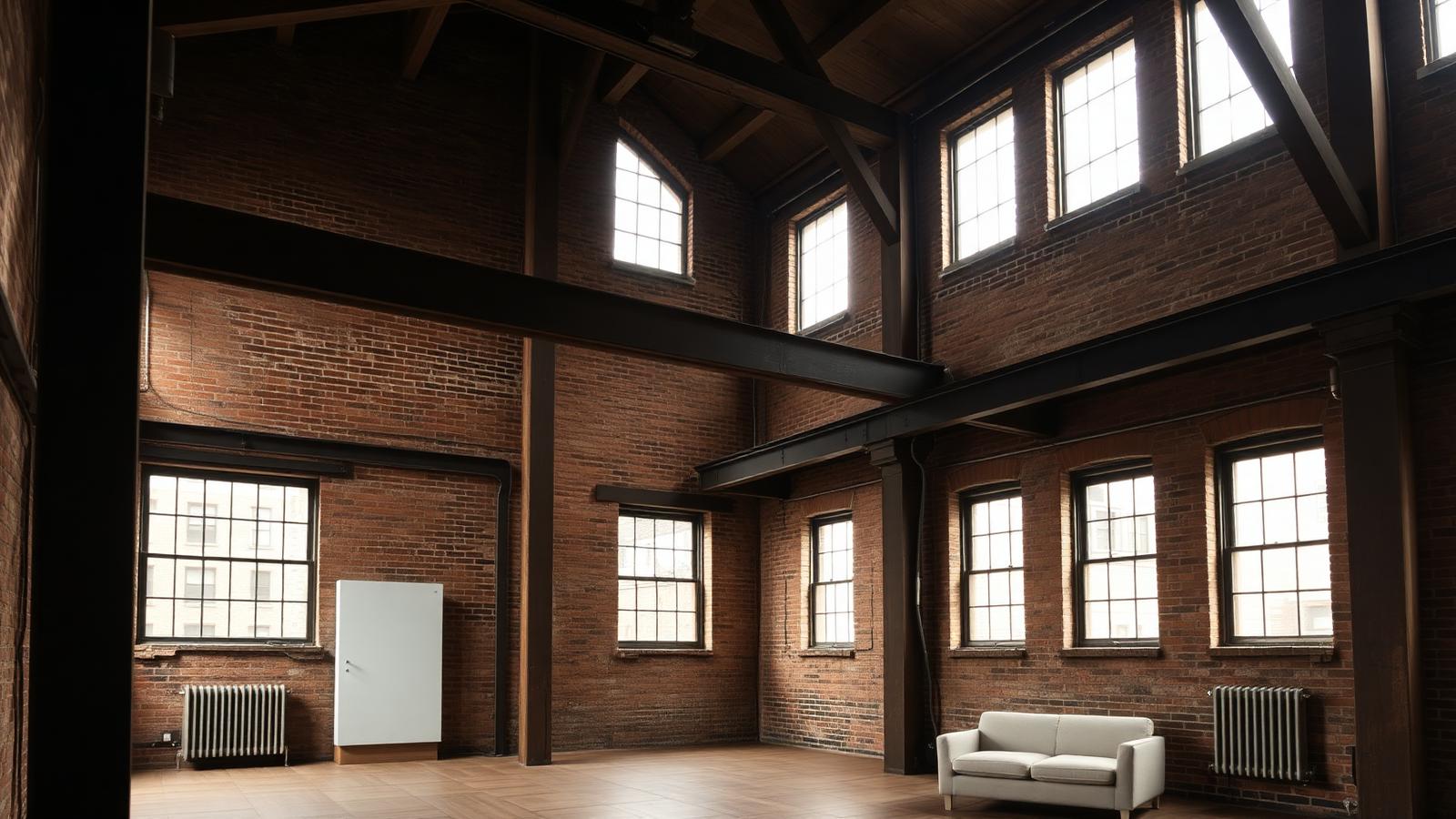
A 1926, 138,000 sq ft factory on the East Side. Three stories, timber-and-steel mix, brick facade with inconsistent window jambs. We scanned it in 3 days (two techs, one VLX3, one RTC360), registered to eight total stations. The model (LOD 300) shipped 12 business days later.
What it changed:
- Uncovered 1.8 inches of sag across a 48 ft bay—structural flagged it early, saved a week of redesign
- Window rough openings varied ±1.25 inches—architects adjusted unit layouts and millwork
- Stair headroom at one landing missed code by 2 inches—design corrected without field change
- Result: 24 RFIs avoided, estimated $190,000 in change orders never materialized, and the team cut three weeks off precon
Preservation comes first. Scanning supports it.
Historic work in Ohio—especially with State and Federal HTC—demands careful treatment of character-defining elements. Laser scanning is a support tool, not a substitute for preservation practice.
How it helps preservation teams:
- Baseline measured drawings for Section 106, HSR updates, and board submissions
- High-fidelity context for window rehab, masonry repair, and storefront reconstructions
- Accurate net/gross area calcs to support HTC applications and pro formas
- Visual records of “before condition” to document integrity
We still rely on traditional methods: hands-on field notes, material sampling, probes, and archival research. The scan simply ensures your drawings match reality and that preservation scope is documented clearly. See how we approach preservation and why modern as-built documentation starts with measured truth.
Tax credits, grants, and the paperwork that wins funding
State and Federal historic tax credits, along with downtown revitalization grants, ask for precision. With a model-backed set, your submission improves.
What reviewers and lenders appreciate:
- Trustworthy GFA and unit-area schedules straight from the model
- Sheet sets with sections/elevations pulled from real geometry
- Photo-tagged point cloud viewpoints for context during review
- Consistency across drawings, narratives, and budgets
When requested, we also prepare 2D CAD backgrounds for consultants who aren’t in Revit. See our Scan to CAD workflow and this primer on turning point clouds into accurate 2D drawings.
Designing around what’s already there
Upper-floor apartments don’t forgive sloppy base data. With an as-built Revit model, architects can:
- Test stackable unit layouts against real column grids and window spacing
- Plan MEP distribution within actual floor-to-floor heights and chase widths
- Coordinate with structural on penetrations and load paths using shared geometry
- Export floor plans, RCPs, and sections that preserve rhythm, proportion, and sightlines
Teams report fewer site walks and fewer “did we measure that?” emails. For a practical workflow, see How Architects Use 3D Scanning to Eliminate Field Visits.
Irregular is normal. We quantify it.
Historic buildings hide surprises:
- Masonry walls out of plumb by 1–2 degrees over a story
- Slabs that dish 1–3 inches bay to bay
- Arched openings with uneven springlines
- Steel that’s not where the 1930s ink drawing shows it
- MEP tangle from five different eras of service
Our point clouds capture as-is geometry. We flag deviations with colorized heatmaps and embed critical dimensions in the model. That’s how you avoid demo-day discoveries.
When should you use mobile LiDAR vs. tripod scanning?
Both have a place. We use each where it performs best.
| Use case | Mobile LiDAR (NavVis VLX3) | Terrestrial (RTC360/Faro Focus) |
|---|---|---|
| Field speed | 50k–80k sq ft/day at walking pace | 200–400 scans/day; slower setup |
| Typical accuracy (registered to control) | ±6–10 mm | ±3–6 mm |
| Best for | Interiors, long corridors, large floor plates | Facades, roofs, stair cores, long-range exteriors |
| Photographic detail | 10–20 MP pano imagery | High-res HDR spheres |
| Deliverable impact | Fast coverage for LOD 200/300 | Tight geometry for selective LOD 350/400 |
| Cost profile | Lower cost per sq ft | Higher per setup; targeted use |
Blending the two yields speed without sacrificing the geometry that matters.
Data, files, and what your team actually receives
Deliverables are built for AEC teams, not file servers.
- Point clouds: E57 master, Autodesk RCP for immediate use; typical 20–40 GB RCP per 150k sq ft
- Revit model: LOD 200/300 core, targeted LOD 350/400 per scope; clean categories and worksets
- 2D sheets on request: floor plans, RCPs, elevations, sections (PDF, DWG)
- Coordination: shared coordinates, levels aligned to survey, northing/easting included
- Metadata: level schedules, door/window schedules from actual measured openings
- Optional: deviation maps, slab flatness grids, photo-keyed viewpoints
Review our technology stack and selected portfolio, including the Downtown Mansfield case study and a Mansfield warehouse turned lofts.
What are the timelines, costs, and savings?
Developers and GCs don’t buy scans—they buy fewer surprises. On adaptive reuse projects, the financial wins show up early.
- Estimating: Real quantities and areas feed precon with fewer assumptions. See Preconstruction Estimating with Point Cloud Data.
- Schedule: A 150k sq ft building typically scans in 3 days and models in 12–15 business days for LOD 300. That’s weeks faster than manual tape/laser workflows.
- Change orders: Clients report 20–40% fewer RFIs tied to existing conditions when the team models from scans. We’ve seen $150k–$300k in avoided change orders on mid-size conversions.
- Financing: Lenders and preservation reviewers trust documented, measurable drawings, especially when paired with photo-backed records.
For contractors, standardizing on scans for renovations is becoming normal. Here’s why many are doing it: Why GCs Standardize on Scan to BIM for Renovations.
Scanning supports adaptive reuse—not the other way around
Adaptive reuse is about economics, character, and constructability. The scan is a support beam in that framework:
- It gives the construction team a baseline.
- It gives engineers constraints they can trust.
- It gives adaptive reuse developers clarity on what they’re buying.
We’ll never skip field notes or small destructive probes just because the point cloud looks pretty. We use both. That’s how you respect a building’s past and deliver apartments that work.
Getting started: scope it right
A quick discovery call sets scope, accuracy targets, and deliverables.
- Building size and number of levels
- Target LOD and disciplines
- Control requirements and any survey integration
- Access windows (active tenants, secure areas)
- Timing relative to tax credit or grant milestones
If you need a spec to share with bidders, start here: How to Write a 3D Scan Deliverable Spec That Protects Your Project. And if this is your first scan, share this prep guide with ownership: How to Prepare Your Site for a 3D Laser Scan.